Loading areas move fast. Trucks, railcars, and crews all compete for space at the same time. Workers still need to reach hatches and valves safely while vehicles and equipment are moving around them. That makes the way workers enter and move through these areas an important part of loading safety.
Every yard has its own layout and hazards. The right access setup keeps foot traffic organized and away from moving equipment. This article covers some of the ways work platforms improve access, plus how to find the right fit for your site.
A Stable, Fixed Point Beats Climbing on the Load
Workers who load and offload trucks and railcars often face uneven footing. Flatbed trailers bring their own access safety challenges, since drivers must climb onto the load itself. Work platforms remove that risk by giving workers solid ground at the right height.
Here is how a fixed platform changes the way workers reach hatches and valves:
- Solid Footing Replaces Guesswork. Standing on a fixed platform means workers plant both feet on stable steel. This removes the balance risk that comes with climbing on curved or wet surfaces.
- Guardrails Keep Workers Contained. A platform's rails create a clear boundary around the work area. Workers stay within that space instead of leaning over open edges.
- Consistent Height Reduces Strain. Workers reach hatches at the same height every time. This cuts down on the stretching and twisting that leads to slips.
When platforms replace climbing, workers have a more stable way to reach elevated work areas. Workers can reach hatches and valves without climbing onto the load or navigating unstable surfaces. That's exactly why a stable base matters most in busy loading areas.
Adjustable Work Platforms Keep Access Level No Matter the Vehicle
A platform built for one trailer height often leaves gaps or awkward reaches on another. That mismatch can force workers to improvise, leading to awkward reaches and less stable footing.
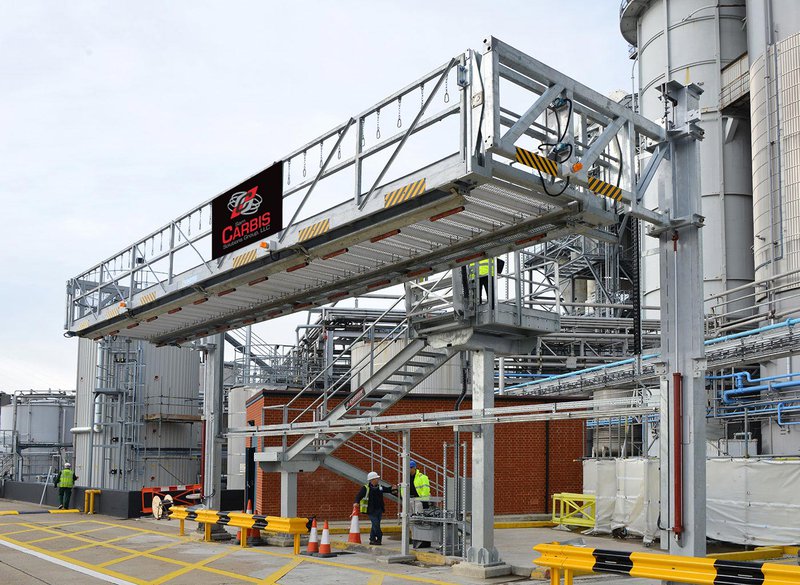
The right setup adjusts to the vehicle instead of forcing workers to adapt. Here is how adjustable work platforms handle that variation:
- Height Adjustment Meets Each Vehicle. Platforms raise or lower to align with the hatch or valve position. Workers get level access whether the vehicle is tall or short.
- Telescoping Sections Close the Gap. Extendable platform sections reach out to meet the vehicle body. This keeps the step-over distance short and consistent.
- Quick Repositioning Supports Mixed Fleets. Sites that load a mix of vehicle types need platforms that reset fast between spots. Operators can adjust the platform quickly between loading positions.
Adjustable platforms keep pace with the variety of vehicles that facilities use instead of forcing workers to compensate. Matching access systems to real-world workflows is what keeps access safe across a mixed fleet.
Clear Layouts Cut Down on Confusion in Multi-Spot Yards
The Occupational Safety and Health Administration (OSHA) names forklifts, vehicle traffic, and struck-by incidents as leading hazards in these environments, per its warehousing safety guidance. A clear layout helps separate workers from vehicle traffic and other hazards. Multi-spot work platforms give each loading position its own defined access point.
Here is what that structure changes on the ground:
- Fixed Positions Remove Guesswork. Each platform marks a specific spot for a specific vehicle. Workers know exactly where to walk without checking for the nearest open space.
- Separate Walkways Reduce Crossover. Dedicated paths keep foot traffic away from vehicle lanes. This cuts down on the number of times workers and moving vehicles share the same space.
- Visual Structure Speeds Up Decisions. A platform's layout signals where work happens and where it does not. Workers spend less time scanning the yard for the safest route.
Confusion in a busy yard rarely comes from one big hazard. It builds from small, repeated decisions made under time pressure. Clear layouts remove that pressure and keep product transfer moving safely.
Separation from Hoses and Moving Equipment Lowers Everyday Risk
Loading areas stay busy with more than just trucks and railcars. Hoses stretch across walkways. Loading arms swing into position. Forklifts and yard trucks move through the same space workers use to reach hatches and valves.

Work platforms create physical separation between workers and this equipment. Here is how that separation lowers everyday risk:
- Guardrails Block Contact with Loading Arms. Platform rails keep workers at a set distance from swinging arms and connections. Workers complete their tasks without stepping into the arm's path.
- Elevated Walkways Clear Ground-Level Hazards. Platforms lift workers above hoses, cables, and other equipment on the ground. This removes the trip hazard that comes with crossing cluttered walkways.
- Defined Boundaries Limit Equipment Overlap. A platform's footprint keeps forklifts and yard vehicles out of the work area. Workers and moving equipment stay in separate zones during product transfer.
Everyday hazards rarely come from a single failure. They build from repeated exposure to moving equipment during routine work. Separation removes that exposure and lets workers focus on the task at hand.
Finding the Right Fit for Your Loading Area
Safer access comes down to giving workers a stable, well-placed platform for the job at hand. Every loading area has its own layout, vehicle types, and hazards to work around. The right platform accounts for all of it instead of forcing workers to adapt.
At Carbis Solutions, we design gangways, platforms, and safety cages built around your specific site conditions. We also provide site assessments and on-site training so each system fits your operation from day one. Reach out to our team to start building a safer access plan for your loading area.