
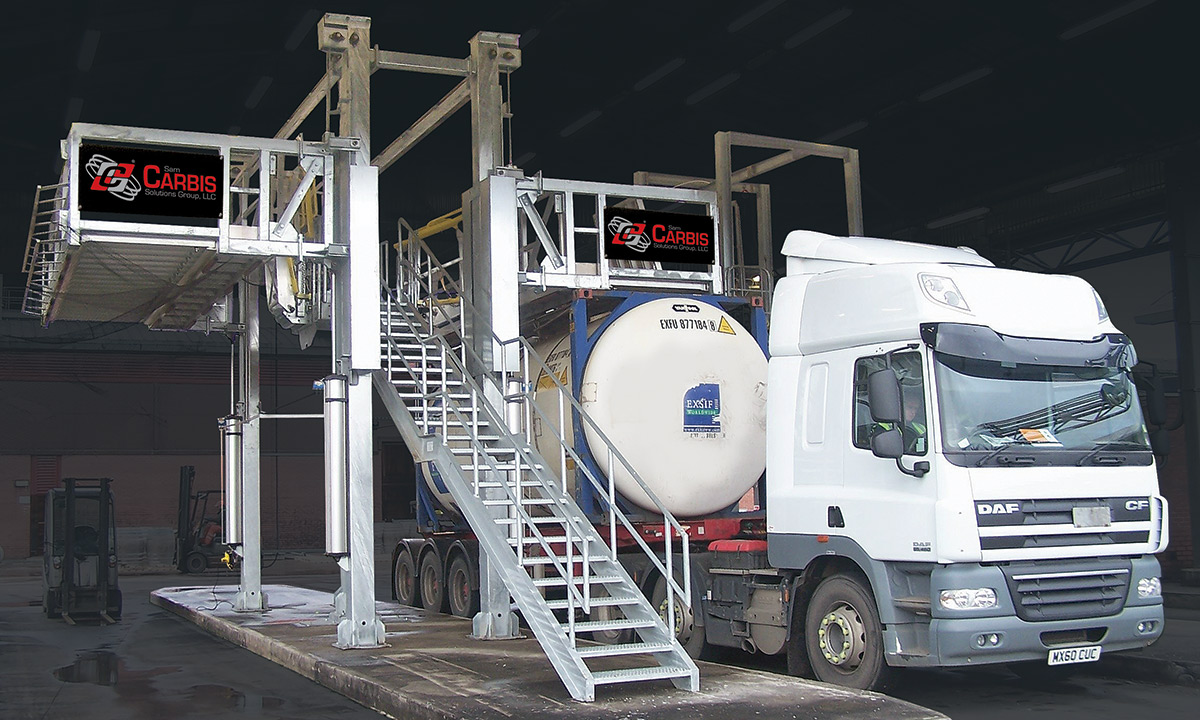
Tank trucks come in a variety of sizes and configurations, which can create a challenge when you’re designing a loading rack that needs to safely accommodate more than one type of vehicle. A system that works well for one truck may not provide the same level of access or fall protection for the next, particularly when there are significant differences in tank height.
An elevating safety cage gives facilities more flexibility by allowing the protected work area to be raised or lowered based on the height of the vehicle. Rather than designing around a single truck profile, the system can accommodate a wider range of vehicles while still providing operators with the fall protection they need when working on top of a tank truck.
What Is an Elevating Safety Cage?
Safety cages are commonly used with gangways to create a protected work area on top of tank trucks. When the gangway is lowered into position, the cage surrounds the operator’s working area and provides a physical barrier between the operator and the exposed edges of the vehicle.
With a traditional system, the relationship between the platform, gangway, and safety cage is generally designed around an expected range of vehicle heights. An elevating cage adds another degree of adjustment by allowing the cage assembly to move vertically, making it possible to position the fall protection at the appropriate working height for different vehicles.
This can be particularly useful at facilities that don’t control the trucks arriving at the loading rack. Common carriers, customer vehicles, and different fleet configurations can result in considerable variation from one load to another, and an elevating cage gives the system the ability to accommodate those differences.
Accommodating Different Vehicle Heights
When designing any loading rack, it’s important to look at the vehicles that will actually use it. If every truck is approximately the same height and configuration, a traditional gangway and safety cage may be a practical solution. When truck heights vary more significantly, however, designing around a single vehicle profile can limit the usefulness of the system.
Elevating cages help address that problem by adjusting the position of the protected work area to better match the vehicle below. The operator isn’t expected to compensate for a truck that’s taller or shorter than the one used as the original design point. Instead, the equipment provides the additional flexibility needed to accommodate a broader operating range.
That flexibility can also make a loading rack more useful over time. Fleets change, carriers change, and equipment changes. Designing some adjustability into the system can help a facility prepare for the variety of vehicles it handles today without assuming those vehicles will always remain the same.
Providing the Right Working Area
Vehicle height is only part of the equation when selecting a safety cage. It’s also important to consider what the operator needs to do once they reach the top of the truck.
Some operations require access to a single hatch, while others may require the operator to move within a larger area to open covers, make product connections, take samples, inspect equipment, or perform other loading and unloading tasks. The size and configuration of the cage should reflect those activities and provide a protected area that makes sense for the way the work is actually performed.
An elevating cage can be engineered around those requirements, taking into consideration the vehicle dimensions, hatch locations, required work area, gangway reach, platform height, and surrounding equipment. Looking at all of these factors together helps create a system that provides both the necessary access and appropriate fall protection.
Designing Flexibility Into the Loading Rack
Variation is one of the realities of truck loading operations, particularly at facilities that work with multiple carriers or vehicle types. The more variation there is between trucks, the more important it becomes to understand the operating range before selecting access and fall protection equipment.
An elevating safety cage can provide a practical solution when that range exceeds what a traditional fixed-height arrangement can comfortably accommodate. By allowing the protected work area to adjust vertically, the system can better match different vehicle heights without requiring operators to adapt their work practices every time a different truck arrives.
Not every loading rack needs an elevating cage and selecting one should be based on the actual requirements of the application. For facilities dealing with significant differences in tank truck heights, however, additional adjustability can provide a safer and more versatile approach to vehicle access.
At Sam Carbis Solutions Group, we look at the vehicles, the work being performed, and the complete loading environment when designing access and fall protection systems. Whether the right solution is a traditional gangway and safety cage or an elevating cage designed for a broader range of vehicles, the goal is the same: provide operators with safe, practical access that works with the realities of the loading operation.