
How Position Switches Improve Safety During Loading Operations

​Loading operations expose workers to serious fall and collision risks whenever equipment moves near a truck, railcar, or vessel. Such movement can happen quickly, leaving little time for workers to react or correct course. Without a way to control that movement, minor missteps can turn into serious safety incidents.

Position switches address these risks by controlling equipment movement before a hazard can develop. They give facilities a dependable safeguard built directly into daily loading operations. In this article, you will learn how position switches improve safety during loading operations.

Preventing Premature Movement During Product Transfer

Product transfer creates one of the highest risk points during loading operations, especially near moving vehicles. Workers often depend on manual checks to confirm equipment is safely positioned before movement continues. However, manual checks can fail under time pressure, leaving little room to catch a mistake.

Position switches remove that uncertainty through the following ways:

  • Confirming Safe Positioning Before Access. The switch verifies that a gangway or loading arm is properly seated before granting worker access.
  • Preventing Vehicle Departure Before Disconnection. It confirms that a gangway or loading arm is fully clear before a vehicle departs.
  • Blocking Movement Until Connection Is Verified. The switch keeps equipment locked until product transfer connections are fully confirmed.
  • Alerting Workers to Unsafe Conditions. This component signals operators immediately if equipment moves outside its confirmed safe position.

Positioning control extends beyond product transfer, supporting broader systems like truck loading platforms that protect workers on-site. When you strengthen positioning control at each stage, you protect both equipment and the workers who depend on it.

Keeping Equipment Within Safe Operating Limits

During loading operations, gangways and loading arms are engineered to move within a specific safe range. Movement beyond that established range can strain equipment or put workers directly at risk. Here is how position switches maintain those operating limits throughout every single shift.
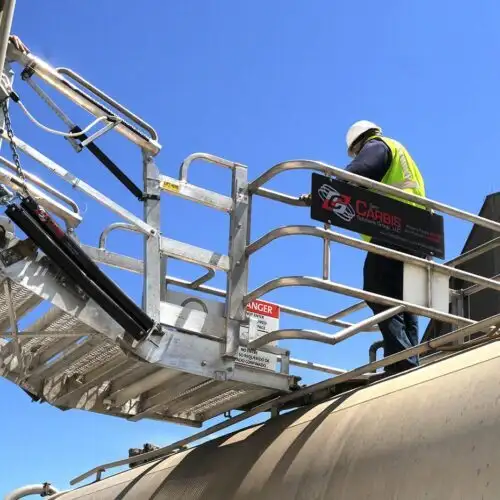
A worker on a loading platform secured with position switches
  • Setting Defined Range Limits During Installation. The switch is calibrated to the equipment's exact safe range from day one.
  • Restricting Movement Beyond Calibrated Boundaries. It stops motion the instant equipment reaches its outer limit.
  • Preserving Calibration Accuracy Over Time. The switch preserves those limits even after repeated daily use.
  • Reducing Wear From Repeated Over-Travel. It protects components by preventing movement past their rated range.

Calibrated switches are just as important as your safety equipment when it comes to reducing fall risks in truck loading operations. The Occupational Safety and Health Administration (OSHA) requires safe clearances around mechanical handling equipment for this exact reason, according to its general materials handling standard. Facilities that hold to those clearances give workers a predictable, defined range to work around each shift.

Keeping equipment within its defined operating range helps prevent unnecessary strain while giving workers a predictable area to work around. Position switches make those limits part of the loading process, helping maintain safe, controlled movement throughout each shift.

Reducing Equipment Damage That Can Create Unsafe Conditions

Equipment damage may begin as a maintenance issue, but it can quickly become a safety hazard during loading operations. A gangway with worn components or a loading arm forced past its limit can quickly become a safety hazard. Position switches help prevent that damage before it puts workers at risk.

Here is how position switches reduce equipment damage across your facility:

  • Preventing Repeated Over-Travel Stress. Components avoid the strain that comes from moving past their rated range.
  • Limiting Impact From Forced Movement. Equipment stays protected when an operator misjudges timing or distance.
  • Catching Small Issues Before They Escalate. Early detection stops minor wear from turning into a larger mechanical failure.
  • Reducing Downtime From Unexpected Repairs. Fewer breakdowns mean fewer disruptions to your loading schedule.

Well-maintained equipment supports safer conditions for every worker on-site. As a result, facilities spend less time managing repairs and more time keeping operations running.

Damage prevention and worker safety are closely connected during loading operations. Equipment that holds up over time gives workers a safer, more reliable environment to work in.

Reducing the Risk of Operator Error During Loading Operations

Operators make dozens of quick decisions during a single loading operation, often under time pressure. A rushed judgment call can lead to a gangway or loading arm moving before it should. Position switches remove some of that pressure by enforcing limits automatically.

A limit position switch installed on a gangway

Here is how position switches reduce the risk of operator error during loading operations:

  • Removing Guesswork From Positioning Decisions. Equipment confirms safe position instead of relying on visual judgment alone.
  • Enforcing Limits Regardless of Experience Level. New and experienced workers get the same built-in protection.
  • Reducing Reliance on Memory-Based Checks. Automated verification replaces steps that depend on memory or habit.
  • Supporting Faster Correction When Conditions Change. Real-time signals help operators respond before a mistake occurs.

Many of the common safety gaps in truck loading trace back to decisions made under pressure with limited backup systems. Automated safeguards close that gap by taking some of that pressure off the operator. When you reduce reliance on manual judgment, you reduce the chance of a costly mistake.

Operator error becomes far less likely when equipment carries part of the safety burden. That shared responsibility gives workers a more reliable and forgiving margin for error.

Build Safer Loading Operations With Carbis Solutions

Position switches give facilities a reliable way to control equipment movement and protect workers during loading operations. Choosing the right position switches for your facility depends on your equipment, layout, and specific risk points. That's why finding the right partner matters just as much as the equipment itself.

Carbis Solutions works closely with facilities to assess site conditions and design systems that fit their exact loading environment. Our team stays involved from early planning through installation and ongoing support. Contact us today to discuss the right safety solution for your facility.

Recent Posts

Why Choose an Elevating Safety Cage?

Tank trucks come in a variety of sizes and configurations, which can create a challenge when you're designing a loading rack that needs to safely accommodate more than one type of vehicle. A system that works well for one truck may not provide the same level of access...

Why Grounding Systems Matter in Tank Truck Operations

​Tank trucks move flammable liquids, chemicals, and powders through loading arms every day, and that motion generates static electricity. Left unmanaged, static charge can spark near vapors and turn a routine...

Key Components That Matter in Loading Arm Performance

​A loading arm does more than move products from one point to another. It's a critical link between your process equipment and the trucks, railcars, or vessels you load. When it performs well, product transfer...

Let’s talk marine access

We use cookies to improve your experience. Please read our Privacy Policy or click Accept.
Cookies settings
Accept
Privacy & Cookie policy
Privacy & Cookies policy
Cookie name Active

Privacy Policy

What information do we collect?

We collect information from you when you register on our site or place an order. When ordering or registering on our site, as appropriate, you may be asked to enter your: name, e-mail address or mailing address.

What do we use your information for?

Any of the information we collect from you may be used in one of the following ways: To personalize your experience (your information helps us to better respond to your individual needs) To improve our website (we continually strive to improve our website offerings based on the information and feedback we receive from you) To improve customer service (your information helps us to more effectively respond to your customer service requests and support needs) To process transactions Your information, whether public or private, will not be sold, exchanged, transferred, or given to any other company for any reason whatsoever, without your consent, other than for the express purpose of delivering the purchased product or service requested. To administer a contest, promotion, survey or other site feature To send periodic emails The email address you provide for order processing, will only be used to send you information and updates pertaining to your order.

How do we protect your information?

We implement a variety of security measures to maintain the safety of your personal information when you place an order or enter, submit, or access your personal information. We offer the use of a secure server. All supplied sensitive/credit information is transmitted via Secure Socket Layer (SSL) technology and then encrypted into our Payment gateway providers database only to be accessible by those authorized with special access rights to such systems, and are required to?keep the information confidential. After a transaction, your private information (credit cards, social security numbers, financials, etc.) will not be kept on file for more than 60 days.

Do we use cookies?

Yes (Cookies are small files that a site or its service provider transfers to your computers hard drive through your Web browser (if you allow) that enables the sites or service providers systems to recognize your browser and capture and remember certain information We use cookies to help us remember and process the items in your shopping cart, understand and save your preferences for future visits, keep track of advertisements and compile aggregate data about site traffic and site interaction so that we can offer better site experiences and tools in the future. We may contract with third-party service providers to assist us in better understanding our site visitors. These service providers are not permitted to use the information collected on our behalf except to help us conduct and improve our business. If you prefer, you can choose to have your computer warn you each time a cookie is being sent, or you can choose to turn off all cookies via your browser settings. Like most websites, if you turn your cookies off, some of our services may not function properly. However, you can still place orders by contacting customer service. Google Analytics We use Google Analytics on our sites for anonymous reporting of site usage and for advertising on the site. If you would like to opt-out of Google Analytics monitoring your behaviour on our sites please use this link (https://tools.google.com/dlpage/gaoptout/)

Do we disclose any information to outside parties?

We do not sell, trade, or otherwise transfer to outside parties your personally identifiable information. This does not include trusted third parties who assist us in operating our website, conducting our business, or servicing you, so long as those parties agree to keep this information confidential. We may also release your information when we believe release is appropriate to comply with the law, enforce our site policies, or protect ours or others rights, property, or safety. However, non-personally identifiable visitor information may be provided to other parties for marketing, advertising, or other uses.

Registration

The minimum information we need to register you is your name, email address and a password. We will ask you more questions for different services, including sales promotions. Unless we say otherwise, you have to answer all the registration questions. We may also ask some other, voluntary questions during registration for certain services (for example, professional networks) so we can gain a clearer understanding of who you are. This also allows us to personalise services for you. To assist us in our marketing, in addition to the data that you provide to us if you register, we may also obtain data from trusted third parties to help us understand what you might be interested in. This ‘profiling’ information is produced from a variety of sources, including publicly available data (such as the electoral roll) or from sources such as surveys and polls where you have given your permission for your data to be shared. You can choose not to have such data shared with the Guardian from these sources by logging into your account and changing the settings in the privacy section. After you have registered, and with your permission, we may send you emails we think may interest you. Newsletters may be personalised based on what you have been reading on theguardian.com. At any time you can decide not to receive these emails and will be able to ‘unsubscribe’. Logging in using social networking credentials If you log-in to our sites using a Facebook log-in, you are granting permission to Facebook to share your user details with us. This will include your name, email address, date of birth and location which will then be used to form a Guardian identity. You can also use your picture from Facebook as part of your profile. This will also allow us and Facebook to share your, networks, user ID and any other information you choose to share according to your Facebook account settings. If you remove the Guardian app from your Facebook settings, we will no longer have access to this information. If you log-in to our sites using a Google log-in, you grant permission to Google to share your user details with us. This will include your name, email address, date of birth, sex and location which we will then use to form a Guardian identity. You may use your picture from Google as part of your profile. This also allows us to share your networks, user ID and any other information you choose to share according to your Google account settings. If you remove the Guardian from your Google settings, we will no longer have access to this information. If you log-in to our sites using a twitter log-in, we receive your avatar (the small picture that appears next to your tweets) and twitter username.

Children’s Online Privacy Protection Act Compliance

We are in compliance with the requirements of COPPA (Childrens Online Privacy Protection Act), we do not collect any information from anyone under 13 years of age. Our website, products and services are all directed to people who are at least 13 years old or older.

Updating your personal information

We offer a ‘My details’ page (also known as Dashboard), where you can update your personal information at any time, and change your marketing preferences. You can get to this page from most pages on the site – simply click on the ‘My details’ link at the top of the screen when you are signed in.

Online Privacy Policy Only

This online privacy policy applies only to information collected through our website and not to information collected offline.

Your Consent

By using our site, you consent to our privacy policy.

Changes to our Privacy Policy

If we decide to change our privacy policy, we will post those changes on this page.
Save settings
Cookies settings