
Moving product across long distances rarely happens through a single mode of transport. Pipelines, railways, and roads do not always connect directly to where the product needs to go. That's where transloading comes in.
Transloading transfers product from one mode of transportation to another, like truck to rail or rail to marine vessel. It helps companies move product efficiently when a direct route is not available. This article covers what transloading is, how it works, and why it matters for your operation.
What is Transloading?
Transloading is the process of transferring product from one mode of transportation to another. This often means moving product between trucks, railcars, and marine vessels. It happens at a terminal built specifically for this purpose.
Companies rely on transloading for several reasons, including:
- Bridges transport gaps. It connects routes when pipelines, railways, or roads don’t reach the final destination.
- Extends market reach. It allows companies to move products into areas not served by a single transport mode.
- Adds shipping flexibility. It gives companies more options when choosing the fastest or most cost-effective route.
- Supports bulk and liquid transport. It plays a key role in moving petroleum, chemicals, and bulk liquid ingredients.
Transloading requires the right equipment and safety measures at every transfer point. Workers need safe access to trucks, railcars, or vessels during the transfer. Without the right setup, transloading can introduce serious safety risks.
How Transloading Works
Transloading follows a fairly consistent process, regardless of the product being moved. It typically takes place at a terminal designed to safely handle the transfer. Here is a general breakdown of how the process works.
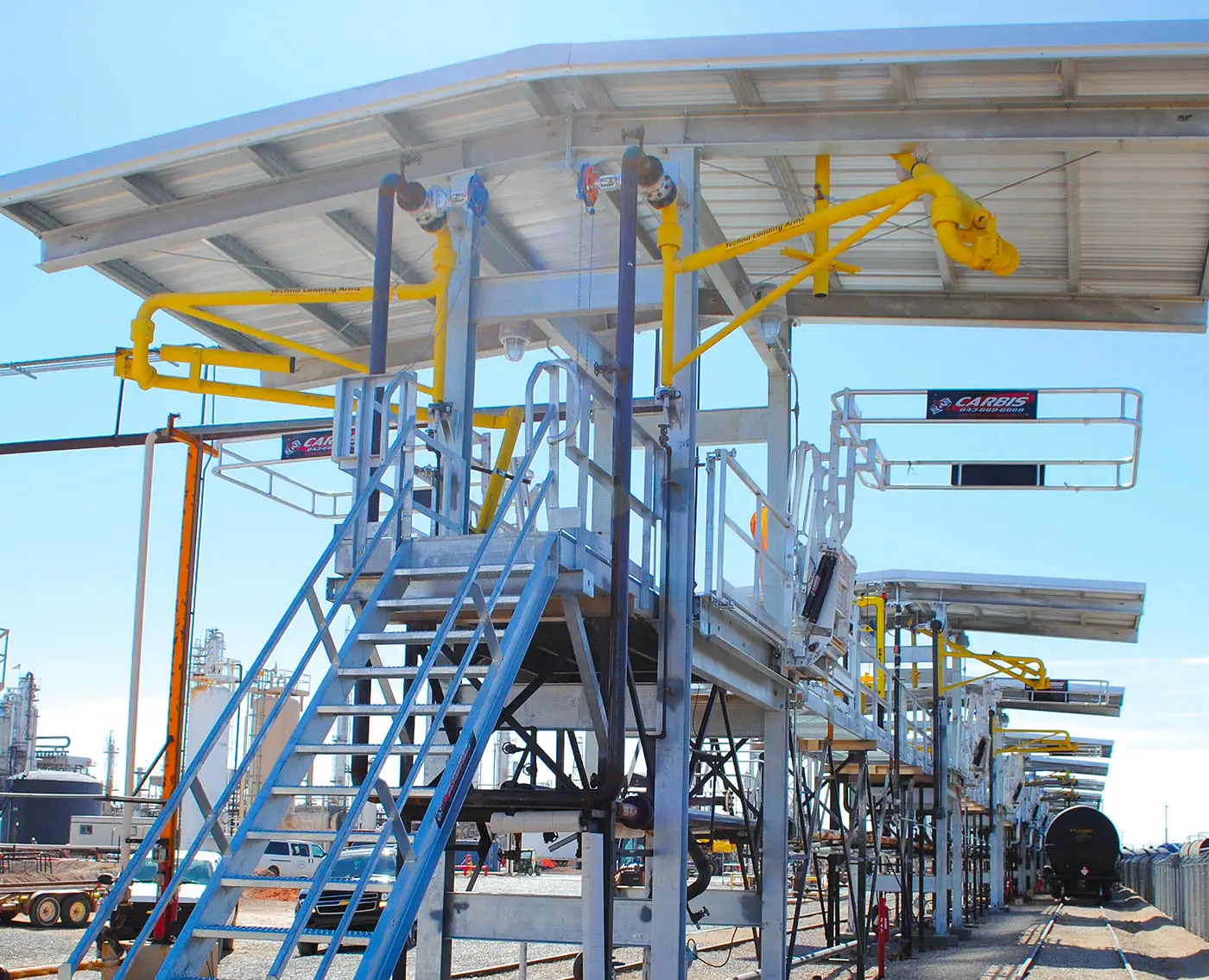
- Arrival at the terminal. A truck, railcar, or marine vessel arrives at the terminal carrying product.
- Positioning for transfer. The vehicle or vessel is positioned at a loading rack or platform built for safe access.
- Worker access setup. Workers use track-mounted gangways, platforms, or stairs to safely reach the transfer point.
- Connection of transfer equipment. Hoses or loading arms connect the source vehicle to the receiving vehicle or storage tank.
- Product transfer. Product moves through the connected equipment, often tracked using metering systems.
- Disconnection and departure. Equipment is disconnected once the transfer is complete, and the vehicle exits the terminal.
Each step requires careful coordination to keep workers safe and product loss to a minimum. A well-designed terminal makes this process smoother and more repeatable.
Why Transloading Matters
Transloading plays a bigger role in supply chains than many companies realize. It affects cost, speed, and flexibility across multiple industries. Understanding why it matters helps companies make smarter shipping decisions.
Demand for transloading continues to grow as companies look for more flexible shipping options. Transloading services now make up a rising share of the rail logistics market. That growth reflects how essential this process has become.
Here is why transloading matters for your operation:
- Expands shipping options. It allows companies to combine truck, rail, and marine transport instead of relying on one mode.
- Reduces shipping costs. It allows companies to use the most cost-effective mode for each leg of the journey.
- Improves supply chain flexibility. It helps companies adapt when infrastructure, weather, or demand disrupts a single route.
- Supports market expansion. It allows companies to reach customers and regions not served by a direct transport line.
None of these benefits matter if the transfer process is not done safely. A single safety gap at a truck unloading platform can put workers at risk and disrupt operations. That's exactly why safe, well-equipped terminals are just as important as the flexibility transloading provides.
Common Safety Risks in Transloading
Transloading involves workers moving around large vehicles, elevated platforms, and pressurized equipment. Each transfer point introduces its own set of hazards. Understanding these risks is the first step toward preventing them.

Here are some of the most common safety risks in transloading operations:
- Falls from height. Workers accessing the tops of tank trucks, railcars, or vessels face fall risks without proper guardrails or platforms.
- Unstable footing. Wet, icy, or uneven surfaces near loading racks increase the risk of slips and trips.
- Improper equipment connections. Incorrectly connected hoses or loading arms can lead to spills or equipment failure.
- Vehicle movement during transfer. A truck or railcar that moves unexpectedly during product transfer can injure nearby workers.
- Product spills and exposure. Leaks or overfills can expose workers to hazardous chemicals or fuels.
These risks rarely show up on their own. A fall hazard often exists alongside a spill risk at the same transfer point. That's why addressing them one at a time is rarely enough.
Partner with Carbis Solutions for Transloading Safety
Transloading keeps products moving, but only when every transfer point is safe. Carbis Solutions takes a full-solution approach to reduce these risks together. Access equipment, containment systems, and enclosures are designed to work as one integrated system rather than separate fixes.
That's exactly what keeps workers safe and operations running without interruption. Our team also provides site assessments, hazard analysis, and on-site training to support every project. Get in touch with our team to build a safer, more efficient transloading operation.