How to Address Common Safety Gaps in Truck Unloading Platforms

​Truck product transfer is one of the most routine operations at industrial facilities, and one of the most hazardous. Workers climb to elevated positions, connect and disconnect loading arms, and manage transfers in conditions that can change by the hour. When the access platform doesn't fit the work, the risk goes up fast.

While many facilities may have platforms in place, they’re not a guarantee to keep operations safe. Gaps in design, fit, and condition create exposure that workers navigate every day, often without a clear alternative.

Here's where those gaps tend to show up, and what actually closes them.

Poor Platform Fit for Vehicle Height Variation

Trucks don't arrive at the same height every time. Tank trailers vary based on product weight, fill level, manufacturer differences, and tire condition. A fixed-height platform that worked well for one fleet may leave workers stretching or stepping awkwardly with another.

That mismatch matters. An improper step height increases the chance of a misstep, especially when workers are managing hoses or loading arms at the same time. Facilities that run mixed fleets or accept third-party carriers are especially exposed to this.
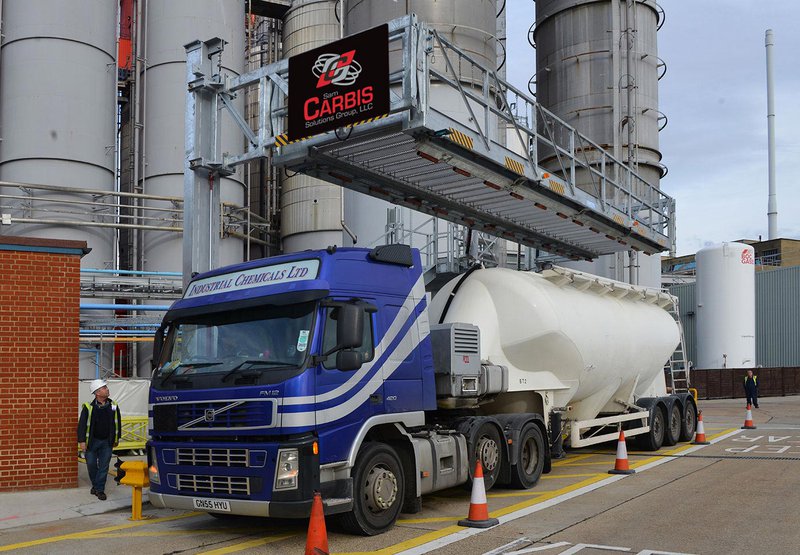
 A blue and white Industrial Chemicals Ltd tanker truck is parked at an industrial facility beneath a Carbis Solutions elevating loading platform
Elevating truck access platform by Carbis Solutions

Elevating truck access platforms solve this by adjusting to meet the vehicle rather than requiring the worker to compensate. Motorized or manual adjustment allows the platform surface to match the actual hatch height, which keeps the working position stable and reduces exposure during transfer.

Inadequate Protection at the Top of the Vehicle

Getting to the top of a tanker is only part of the job. Workers need to move around the hatch area to connect equipment, check valves, and manage the transfer. That's where many platforms fall short.

A basic gangway that reaches the top of the truck doesn't automatically provide protection while the worker is working. Without a safety cage or enclosure around the hatch area, the worker is exposed on all sides.

Safety cages address this by creating a defined, protected work zone at the top of the vehicle. Options range from standard handrail configurations to full enclosures depending on the operation. For dry bulk applications, Carbis also offers cage designs with lift-up panels so hatches can be opened and closed without raising the entire cage structure, which saves time and reduces unnecessary movement.

The right cage configuration depends on:

  • The type of product being transferred
  • The frequency and duration of access
  • Whether workers need to access multiple hatches
  • Environmental conditions at the site

Gangways That Don't Reach or Move Reliably

A gangway that doesn't deploy smoothly is a problem every time a truck arrives. Workers under pressure to move product quickly may push equipment that isn't cooperating, skip steps in the process, or position themselves in ways that create risk.

The image shows a gangway platform from Carbis.

Gangway reliability comes down to design and maintenance. Self-leveling gangways keep the walking surface level regardless of deployment angle, which is important when trucks aren't spotted perfectly every time. Track-mounted systems allow the gangway to travel horizontally along the platform to reach vehicles that stop short or pull past the ideal position.

Carbis gangway systems are built for real site conditions, not ideal ones. That includes facilities where truck positioning varies, traffic flow is tight, or multiple trucks move through the same rack position throughout a shift.

Worn or Outdated Equipment That Creates Hidden Hazards

A platform that was correctly designed and installed years ago may not be performing at the same standard today. Wear on pivot points, degraded slip-resistant surfaces, corroded structural members, and failing safety components all reduce the effectiveness of the system, often in ways that aren't immediately obvious.

The risk here is that workers adapt. They learn the workarounds. They avoid the gangway section that doesn't lock cleanly, or they step around the surface area where traction has worn off. Those workarounds become routine, and the hazard stops getting flagged.

Signs that a platform system may have reached this point include:

  • Visible surface wear on stairs, walking areas, or platform decking
  • Gangway deployment that requires extra effort or adjustment
  • Cracked or broken welds
  • Corrosion on structural members, pivot points, or hardware
  • Cage components that don't latch, align, or hold position correctly
  • Increasing frequency of maintenance calls on the same components

Carbis site assessments are designed to surface these issues before they lead to an incident. An experienced team reviews the mechanical condition of existing equipment, identifies gaps in fit and coverage, and provides a clear picture of what needs to be addressed, whether that's maintenance, component replacement, or a more significant system upgrade.

Workers Operating Equipment Without Consistent Training

Equipment that workers don't fully understand creates risk regardless of how well it's designed. New hires, temporary workers, and workers who switch between facilities often operate access systems without formal instruction on the specific equipment they're using.

OSHA 1910.30 requires that workers be trained on hazard awareness and the proper operation of the equipment they use. Meeting that standard in practice means more than a general safety orientation. It means instruction on the specific platform, gangway, and cage system in use at that facility.

Carbis training programs include on-site instruction, online options, and train-the-trainer formats that allow facilities to sustain their own programs over time. The goal is that every worker who steps onto a truck access platform understands how to use the equipment correctly, what hazards to watch for, and what to do when conditions aren't normal.

Addressing the Gaps as a System

Truck product transfer safety doesn't come from fixing one thing. A well-designed gangway connected to a platform that doesn't fit the vehicle still creates risk. A properly fitted platform with no cage coverage still leaves workers exposed at the top. Equipment in good condition operated without training still creates exposure.

The facilities that reduce incident rates consistently treat access as a complete system. That means the platform, gangway, cage, and training all work together, and the system is reviewed and maintained over time.

Carbis designs and builds complete truck access solutions with that in mind. From initial site assessment through engineering, manufacturing, installation, and operator training, the focus is on a system that fits your operation and keeps your workers safer every day.

If you're seeing gaps in your current setup, contact the Carbis team to start with a site assessment.

Recent Posts

Fixed vs Portable Gangway: Which Is Right for Your Operation?

​ Choosing between a fixed and a portable gangway shapes how your team accesses trucks, railcars, or vessels every day. Both improve safety at height, but they solve different problems. A fixed gangway stays in place, built for a consistent loading point. Meanwhile, a...

Managing Access Risks With Ship Gangway Systems

​A ship gangway system is one of the most important tools for managing access risk at loading areas. Deck heights shift with tides and cargo loads, so workers need a stable, adjustable access path every time a vessel...

Designing Safe Gangway Systems for Ships and Barges

​Designing a gangway takes more than picking equipment off a shelf. It's a safety-critical system that connects the dock to the vessel, giving workers a secure path on and off during product transfer. Get the...

Let’s talk marine access

We use cookies to improve your experience. Please read our Privacy Policy or click Accept.
Cookies settings
Accept
Privacy & Cookie policy
Privacy & Cookies policy
Cookie name Active

Privacy Policy

What information do we collect?

We collect information from you when you register on our site or place an order. When ordering or registering on our site, as appropriate, you may be asked to enter your: name, e-mail address or mailing address.

What do we use your information for?

Any of the information we collect from you may be used in one of the following ways: To personalize your experience (your information helps us to better respond to your individual needs) To improve our website (we continually strive to improve our website offerings based on the information and feedback we receive from you) To improve customer service (your information helps us to more effectively respond to your customer service requests and support needs) To process transactions Your information, whether public or private, will not be sold, exchanged, transferred, or given to any other company for any reason whatsoever, without your consent, other than for the express purpose of delivering the purchased product or service requested. To administer a contest, promotion, survey or other site feature To send periodic emails The email address you provide for order processing, will only be used to send you information and updates pertaining to your order.

How do we protect your information?

We implement a variety of security measures to maintain the safety of your personal information when you place an order or enter, submit, or access your personal information. We offer the use of a secure server. All supplied sensitive/credit information is transmitted via Secure Socket Layer (SSL) technology and then encrypted into our Payment gateway providers database only to be accessible by those authorized with special access rights to such systems, and are required to?keep the information confidential. After a transaction, your private information (credit cards, social security numbers, financials, etc.) will not be kept on file for more than 60 days.

Do we use cookies?

Yes (Cookies are small files that a site or its service provider transfers to your computers hard drive through your Web browser (if you allow) that enables the sites or service providers systems to recognize your browser and capture and remember certain information We use cookies to help us remember and process the items in your shopping cart, understand and save your preferences for future visits, keep track of advertisements and compile aggregate data about site traffic and site interaction so that we can offer better site experiences and tools in the future. We may contract with third-party service providers to assist us in better understanding our site visitors. These service providers are not permitted to use the information collected on our behalf except to help us conduct and improve our business. If you prefer, you can choose to have your computer warn you each time a cookie is being sent, or you can choose to turn off all cookies via your browser settings. Like most websites, if you turn your cookies off, some of our services may not function properly. However, you can still place orders by contacting customer service. Google Analytics We use Google Analytics on our sites for anonymous reporting of site usage and for advertising on the site. If you would like to opt-out of Google Analytics monitoring your behaviour on our sites please use this link (https://tools.google.com/dlpage/gaoptout/)

Do we disclose any information to outside parties?

We do not sell, trade, or otherwise transfer to outside parties your personally identifiable information. This does not include trusted third parties who assist us in operating our website, conducting our business, or servicing you, so long as those parties agree to keep this information confidential. We may also release your information when we believe release is appropriate to comply with the law, enforce our site policies, or protect ours or others rights, property, or safety. However, non-personally identifiable visitor information may be provided to other parties for marketing, advertising, or other uses.

Registration

The minimum information we need to register you is your name, email address and a password. We will ask you more questions for different services, including sales promotions. Unless we say otherwise, you have to answer all the registration questions. We may also ask some other, voluntary questions during registration for certain services (for example, professional networks) so we can gain a clearer understanding of who you are. This also allows us to personalise services for you. To assist us in our marketing, in addition to the data that you provide to us if you register, we may also obtain data from trusted third parties to help us understand what you might be interested in. This ‘profiling’ information is produced from a variety of sources, including publicly available data (such as the electoral roll) or from sources such as surveys and polls where you have given your permission for your data to be shared. You can choose not to have such data shared with the Guardian from these sources by logging into your account and changing the settings in the privacy section. After you have registered, and with your permission, we may send you emails we think may interest you. Newsletters may be personalised based on what you have been reading on theguardian.com. At any time you can decide not to receive these emails and will be able to ‘unsubscribe’. Logging in using social networking credentials If you log-in to our sites using a Facebook log-in, you are granting permission to Facebook to share your user details with us. This will include your name, email address, date of birth and location which will then be used to form a Guardian identity. You can also use your picture from Facebook as part of your profile. This will also allow us and Facebook to share your, networks, user ID and any other information you choose to share according to your Facebook account settings. If you remove the Guardian app from your Facebook settings, we will no longer have access to this information. If you log-in to our sites using a Google log-in, you grant permission to Google to share your user details with us. This will include your name, email address, date of birth, sex and location which we will then use to form a Guardian identity. You may use your picture from Google as part of your profile. This also allows us to share your networks, user ID and any other information you choose to share according to your Google account settings. If you remove the Guardian from your Google settings, we will no longer have access to this information. If you log-in to our sites using a twitter log-in, we receive your avatar (the small picture that appears next to your tweets) and twitter username.

Children’s Online Privacy Protection Act Compliance

We are in compliance with the requirements of COPPA (Childrens Online Privacy Protection Act), we do not collect any information from anyone under 13 years of age. Our website, products and services are all directed to people who are at least 13 years old or older.

Updating your personal information

We offer a ‘My details’ page (also known as Dashboard), where you can update your personal information at any time, and change your marketing preferences. You can get to this page from most pages on the site – simply click on the ‘My details’ link at the top of the screen when you are signed in.

Online Privacy Policy Only

This online privacy policy applies only to information collected through our website and not to information collected offline.

Your Consent

By using our site, you consent to our privacy policy.

Changes to our Privacy Policy

If we decide to change our privacy policy, we will post those changes on this page.
Save settings
Cookies settings