
Integrating Loading Arms with Access Platforms for Safer Operations

​Loading arms move product quickly and safely between transfer points. But this speed is only helpful if workers can also reach the connection point safely.

Access platforms give workers stable footing to connect and disconnect equipment. When platforms and arms aren't designed together, gaps between the two systems are more evident. Workers end up stretching, climbing, or working from unstable positions, which can quickly become a safety risk.

This is also why ensuring a well-integrated design for loading arms matters. When these safety solutions work as one system, facilities not only make product transfers efficient but also keep workers protected.

Common Challenges with Integrating Loading Arms

Loading arms and access platforms often get specified by different teams on different timelines. One team focuses on product transfer equipment. Meanwhile, another handles worker safety and access.

This distribution in tasks may seem efficient. However, in reality, it means the two systems aren't always designed with each other in mind. Add in the range of trucks, railcars, and vessels a site might handle, and the challenge compounds. A platform built for one vehicle height may not serve another.

These mismatches often go unnoticed until installation, when retrofitting costs more time and money than planning ahead. The result is a system that technically works but leaves gaps in worker safety.

These issues tend to show up in a few common ways:

  • Swing radius conflicts. Platforms built without the arm's full range of motion can end up in its path. This forces workers to navigate around moving equipment.
  • Fixed platform heights. A platform set at one height struggles to serve vehicles or vessels with different hatch levels. This creates gaps between the platform edge and the connection point, raising the risk of a fall.
  • Vehicle and vessel variability. Trucks, railcars, and marine vessels rarely share the same dimensions, so a platform built for one may leave workers unsupported on another.
  • Separate design timelines. When the arm and platform are specified independently, compatibility gaps may not surface until installation, when correcting them can create additional safety risks for workers.
  • Worker exposure at the connection point. Poor platform layout raises the chance of missteps or lost footing while workers handle a loaded arm.

These challenges carry real weight. According to the Occupational Safety and Health Administration (OSHA), there were over 380 fatal falls in 2024. Addressing compatibility early helps avoid becoming part of that statistic.

Why Loading Arms and Access Platforms Need to Work Together

A loading arm and a platform serve two halves of the same job. One moves product. The other gets workers safely to the connection point. Neither does much good without the other.

A railcar with a secure enclosure around the loading arm

When these systems are designed together, the benefits go beyond convenience. They shape how safely and efficiently a site actually runs. Moreover, they deliver the following advantages:

  • Consistent clearance and reach. A platform designed around the arm's swing radius keeps workers clear of moving equipment during every transfer.
  • Better training outcomes. Workers trained on a system built to work together develop more consistent, safer habits over time.
  • Faster, more predictable operations. When the platform and arm work together, workers spend less time adjusting position and more time on the task.
  • Simplified maintenance. Systems designed together are easier to service, since access points and equipment paths are documented from the start.
  • Stronger long-term reliability. Systems built to work together tend to hold up better under daily use, since neither piece is straining against the other's limitations.

Choosing the right loading arm from the start makes this coordination easier. Selecting an arm suited to the operation, and not just the product being transferred, gives platform designers a clear foundation to work from. That's the real case for integration. It's not just about two pieces of equipment fitting together. It's about building a system workers can rely on every time they're at height.

What to Consider When Integrating Loading Arms with Access Platforms

Every site handles a different mix of vehicles, layout, and product transfer needs. A terminal loading tank trucks all day looks nothing like a rail facility cycling through railcars of varying heights. Even sites handling similar vehicles often differ in throughput, space, and existing infrastructure.

That mix should guide how the loading arm and platform get designed together. What works at one site may create clearance issues or awkward worker positioning at another. Treating each site's specifics as the starting point helps avoid those mismatches.

Below, we outline a few factors that deserve close attention:

  • Platform type. Fixed, elevated, and portable platforms each suit different operations. The right choice depends on how consistent your vehicle heights and positions are.
  • Arm specifications. Documenting the arm's reach, swing radius, and stow position gives platform designers the information they need before finalizing the layout.
  • Future flexibility. Sites expecting to add vehicle types or expand throughput should design platforms with room to adapt.
  • Worker positioning. Handrails, gates, and platform layout should give workers stable footing and clear sightlines at the connection point.
  • Site constraints. Space limitations, existing infrastructure, and future throughput needs all shape what's realistic to install.
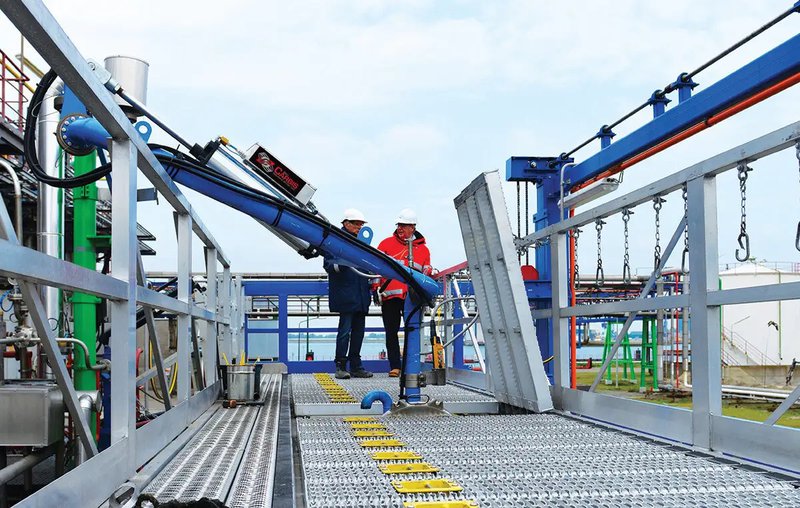
Two workers walking on an access platform with an integrated loading arm

These factors often surface gaps that aren't obvious until a platform is already in use. Addressing common safety gaps in access platforms early keeps small issues from turning into bigger ones later.

Getting these considerations right takes more than a checklist. It takes a design process where both pieces are engineered side by side, not chosen separately.

Partner With Us for Integrated Access Systems

Loading arms and access platforms only deliver real safety when they're designed together, not bolted on as separate purchases. That coordination protects workers and keeps product transfer running smoothly. It's the foundation every site should build on.

At Carbis Solutions, we design loading arms and access platforms as one integrated system, backed by site assessments and hands-on engineering support. Our team works with you from early planning through installation to make sure both pieces fit your operation. Get in touch with our team to start designing a system built around your site.

Recent Posts

Safer Access. Faster Loading. Smarter Operations.

In bulk loading operations, efficiency often depends on how quickly and safely crews can access multiple hatches on tanker trucks or railcars. Whether transferring chemicals, petroleum products, food-grade materials, or other commodities, operators face the same...

Why Choose an Elevating Safety Cage?

Tank trucks come in a variety of sizes and configurations, which can create a challenge when you're designing a loading rack that needs to safely accommodate more than one type of vehicle. A system that works well for one truck may not provide the same level of access...

Why Grounding Systems Matter in Tank Truck Operations

​Tank trucks move flammable liquids, chemicals, and powders through loading arms every day, and that motion generates static electricity. Left unmanaged, static charge can spark near vapors and turn a routine...

Let’s talk marine access

We use cookies to improve your experience. Please read our Privacy Policy or click Accept.
Cookies settings
Accept
Privacy & Cookie policy
Privacy & Cookies policy
Cookie name Active

Privacy Policy

What information do we collect?

We collect information from you when you register on our site or place an order. When ordering or registering on our site, as appropriate, you may be asked to enter your: name, e-mail address or mailing address.

What do we use your information for?

Any of the information we collect from you may be used in one of the following ways: To personalize your experience (your information helps us to better respond to your individual needs) To improve our website (we continually strive to improve our website offerings based on the information and feedback we receive from you) To improve customer service (your information helps us to more effectively respond to your customer service requests and support needs) To process transactions Your information, whether public or private, will not be sold, exchanged, transferred, or given to any other company for any reason whatsoever, without your consent, other than for the express purpose of delivering the purchased product or service requested. To administer a contest, promotion, survey or other site feature To send periodic emails The email address you provide for order processing, will only be used to send you information and updates pertaining to your order.

How do we protect your information?

We implement a variety of security measures to maintain the safety of your personal information when you place an order or enter, submit, or access your personal information. We offer the use of a secure server. All supplied sensitive/credit information is transmitted via Secure Socket Layer (SSL) technology and then encrypted into our Payment gateway providers database only to be accessible by those authorized with special access rights to such systems, and are required to?keep the information confidential. After a transaction, your private information (credit cards, social security numbers, financials, etc.) will not be kept on file for more than 60 days.

Do we use cookies?

Yes (Cookies are small files that a site or its service provider transfers to your computers hard drive through your Web browser (if you allow) that enables the sites or service providers systems to recognize your browser and capture and remember certain information We use cookies to help us remember and process the items in your shopping cart, understand and save your preferences for future visits, keep track of advertisements and compile aggregate data about site traffic and site interaction so that we can offer better site experiences and tools in the future. We may contract with third-party service providers to assist us in better understanding our site visitors. These service providers are not permitted to use the information collected on our behalf except to help us conduct and improve our business. If you prefer, you can choose to have your computer warn you each time a cookie is being sent, or you can choose to turn off all cookies via your browser settings. Like most websites, if you turn your cookies off, some of our services may not function properly. However, you can still place orders by contacting customer service. Google Analytics We use Google Analytics on our sites for anonymous reporting of site usage and for advertising on the site. If you would like to opt-out of Google Analytics monitoring your behaviour on our sites please use this link (https://tools.google.com/dlpage/gaoptout/)

Do we disclose any information to outside parties?

We do not sell, trade, or otherwise transfer to outside parties your personally identifiable information. This does not include trusted third parties who assist us in operating our website, conducting our business, or servicing you, so long as those parties agree to keep this information confidential. We may also release your information when we believe release is appropriate to comply with the law, enforce our site policies, or protect ours or others rights, property, or safety. However, non-personally identifiable visitor information may be provided to other parties for marketing, advertising, or other uses.

Registration

The minimum information we need to register you is your name, email address and a password. We will ask you more questions for different services, including sales promotions. Unless we say otherwise, you have to answer all the registration questions. We may also ask some other, voluntary questions during registration for certain services (for example, professional networks) so we can gain a clearer understanding of who you are. This also allows us to personalise services for you. To assist us in our marketing, in addition to the data that you provide to us if you register, we may also obtain data from trusted third parties to help us understand what you might be interested in. This ‘profiling’ information is produced from a variety of sources, including publicly available data (such as the electoral roll) or from sources such as surveys and polls where you have given your permission for your data to be shared. You can choose not to have such data shared with the Guardian from these sources by logging into your account and changing the settings in the privacy section. After you have registered, and with your permission, we may send you emails we think may interest you. Newsletters may be personalised based on what you have been reading on theguardian.com. At any time you can decide not to receive these emails and will be able to ‘unsubscribe’. Logging in using social networking credentials If you log-in to our sites using a Facebook log-in, you are granting permission to Facebook to share your user details with us. This will include your name, email address, date of birth and location which will then be used to form a Guardian identity. You can also use your picture from Facebook as part of your profile. This will also allow us and Facebook to share your, networks, user ID and any other information you choose to share according to your Facebook account settings. If you remove the Guardian app from your Facebook settings, we will no longer have access to this information. If you log-in to our sites using a Google log-in, you grant permission to Google to share your user details with us. This will include your name, email address, date of birth, sex and location which we will then use to form a Guardian identity. You may use your picture from Google as part of your profile. This also allows us to share your networks, user ID and any other information you choose to share according to your Google account settings. If you remove the Guardian from your Google settings, we will no longer have access to this information. If you log-in to our sites using a twitter log-in, we receive your avatar (the small picture that appears next to your tweets) and twitter username.

Children’s Online Privacy Protection Act Compliance

We are in compliance with the requirements of COPPA (Childrens Online Privacy Protection Act), we do not collect any information from anyone under 13 years of age. Our website, products and services are all directed to people who are at least 13 years old or older.

Updating your personal information

We offer a ‘My details’ page (also known as Dashboard), where you can update your personal information at any time, and change your marketing preferences. You can get to this page from most pages on the site – simply click on the ‘My details’ link at the top of the screen when you are signed in.

Online Privacy Policy Only

This online privacy policy applies only to information collected through our website and not to information collected offline.

Your Consent

By using our site, you consent to our privacy policy.

Changes to our Privacy Policy

If we decide to change our privacy policy, we will post those changes on this page.
Save settings
Cookies settings