Tank truck loading areas are among the most demanding work environments in industrial operations. Workers move between ground level and the tops of vehicles repeatedly throughout a shift, often under time pressure, in changing weather, and near pressurized or hazardous materials. The access equipment in those areas is not a secondary concern. It directly shapes how safely workers can do their jobs.
Poor access design forces improvisation. When gangways don't reach properly, when platforms aren't stable, or when there's no secure overhead support at the hatch, workers adapt in ways that increase their exposure. Tank truck safety depends on getting the access system right before those habits form.
Why Tank Truck Loading Access Carries Unique Risk
Loading a tank truck isn't a simple task. The worker has to climb to the top of the vehicle, open a hatch, connect transfer equipment, monitor the load, then disconnect and descend. That sequence involves multiple elevation changes and working at height with limited space and moving parts nearby.
Several factors make this particularly demanding:
- Vehicle height variation. Different tank trucks arrive at different heights depending on cargo, manufacturer, and configuration. Fixed platforms don't always reach the right position.
- Weather exposure. Workers on top of a tank truck deal with rain, ice, wind, and heat with no natural shelter unless the facility provides it.
- Slippery surfaces. Product residue, condensation, and precipitation create slip hazards on both the truck and the access equipment.
- Hatch operation. Opening and closing a pressurized hatch requires two hands and a stable footing that isn't always available with basic access setups.
Each of these conditions is manageable with the right system in place.
What Effective Tank Truck Access Equipment Needs to Do
A well-designed access system for tank truck loading does more than get workers to the top of the vehicle. It supports them throughout the full task, from the moment they step off the ground until they're safely back on it.
That means the system needs to account for:
- Reach and adjustment. Gangways should accommodate the range of vehicle heights and positions that actually arrive at the facility. Self-leveling gangways keep the walking surface stable regardless of deployment angle, which matters when vehicles aren't spotted perfectly every time. Track-mounted systems allow horizontal adjustment along the platform, removing the expectation that every driver will park in exactly the same spot.
- Overhead protection at the hatch. Once a worker is on top of the tank truck, a safety cage provides continuous protection around the work area. A full cage enclosure gives workers something to hold onto and keeps them from stepping too close to an unprotected edge while their hands are occupied with hatch operation or transfer equipment.
- Stable footing from start to finish. Slip-resistant surfaces on stairs, gangways, and platforms matter. So does the design of the transition point where the gangway meets the vehicle. A gap, an uneven edge, or a surface that shifts under load creates a hazard at exactly the moment when a worker's attention is on something else.
- Weather protection. Loading rack enclosures and canopies extend the range of conditions under which workers can operate safely. They also keep access equipment surfaces drier, which reduces slip risk throughout the shift.
Planning the Layout Before Specifying Equipment
Tank truck safety starts with how the loading area itself is designed. Equipment choices matter, but they have to fit the site. A few layout factors that directly affect how access equipment performs:
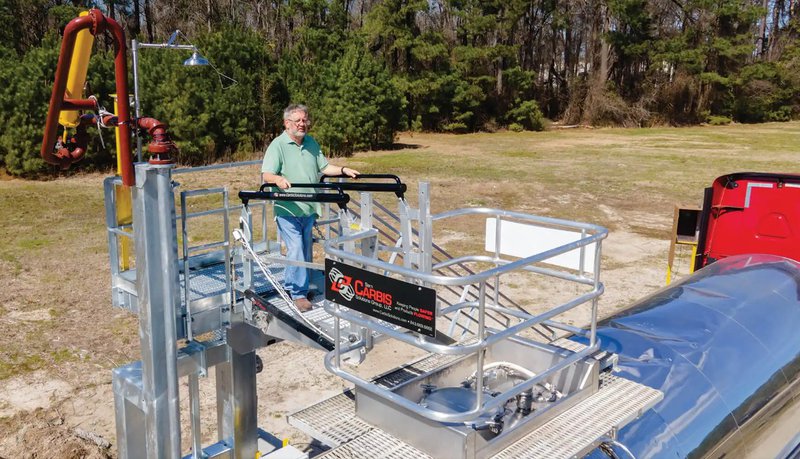
- Spotting consistency. If vehicles regularly stop in different positions, the access system needs to compensate. Fixed platforms work well when spotting is precise. Adjustable or track-mounted systems work better when it isn't.
- Traffic flow. Workers, vehicles, hoses, and ground-level personnel all share the loading area. The platform and gangway design needs to account for how people move through the space, not just how they reach the top of the truck.
- Number of loading spots. A single-spot platform serves a dedicated product line well. Multi-spot systems increase throughput but require more coordination in the access design to make sure workers aren't crossing paths at height.
- Environmental exposure. A coastal or northern facility has different corrosion and traction needs than an inland operation. Material selection and surface treatment should reflect the actual conditions, not a standard assumption.
A site assessment before specifying equipment helps identify the variables that a catalog selection process won't catch.
Maintenance and Training Keep the System Working
Access equipment that isn't maintained becomes unreliable. Gangways that don't extend smoothly, latches that stick, or handrails that have worked loose all create risk in the moment when a worker is depending on them. A regular inspection schedule is part of what makes a safe-access system actually safe over time.

Training matters just as much. Workers who understand how the equipment works and why each element is there are more likely to use it correctly. That includes knowing how to operate self-leveling features, where to position themselves during hatch access, and what to do when a vehicle isn't spotted in the expected position.
Carbis provides on-site and online training programs that are tailored to the specific equipment in use. That specificity makes a difference. Generic safety training doesn't prepare workers for the actual system they'll be using every day.
Choosing the Right Partner for the Full Solution
Tank truck safety isn't solved by a single piece of equipment. It comes from a system where the platform, gangway, cage, enclosure, and site layout all work together. That requires a provider who understands the full picture, not just the individual components.
Carbis designs and builds complete access systems for truck loading areas, from initial site assessment through engineering, fabrication, installation, and ongoing support. If your current setup relies on workarounds or hasn't kept pace with your operation, it's worth a conversation. Contact the Carbis team to talk through what your site actually needs.