
Turning Near-Miss Data into Safer Access Design to Reduce Fall Risk

​Many companies collect near-miss reports as part of assessing fall risk at loading areas. Yet raw data alone rarely turns into safer outcomes without careful review and follow-up. You need to know how to collect and analyze this data to make it actionable.

In this article, we will discuss how to build near-miss reporting habits that generate useful data for fall risk prevention. Reviewing them closely also reveals how reports translate into smarter access design choices over time. With this, you can better understand practical steps to reduce fall risk at your site.

What Near-Miss Data Tells You About Fall Risk

Near-miss reports carry warning signs about fall risk, even when nobody gets hurt. Safety teams that review these reports closely start noticing patterns instead of treating each event separately. Those patterns often point directly to weak spots in access design at truck, rail, and marine terminals.

A closer look at near-miss reports typically reveals the following details about how and where fall risk shows up on site.

  • High-Risk Areas. Certain platforms, gangways, or loading zones show up again and again in reports, signaling a design or layout problem.
  • Common Task Triggers. Some near misses cluster around specific tasks, like reaching for valves or connecting hoses without proper support.
  • Equipment Gaps. Reports often mention missing handrails, unstable footing, or platforms that do not match the height of the vehicle or railcar.
  • Timing Patterns. Near misses tend to spike during shift changes, weather events, or periods of rushed work. A National Institute for Occupational Safety and Health (NIOSH) case study that coded 167 valid near-miss reports found 30% rated high risk and 26% critical.

Individually, these details might look minor or unrelated. Viewed together, they build a clearer picture of where and why workers face elevated risk. That bigger picture is what turns scattered reports into a real case for design change.

How to Ensure Effective Near-Miss Reporting

Reporting a near miss only helps when the report captures the right details. Vague descriptions make it hard to spot patterns tied to fall risk later on. Workers need clear guidance and training so every report includes information safety teams can use.

A worker walking on a railcar platform built with fall risk protection

Effective reporting depends on the details you gather every time a near miss occurs, including:

  • Location and Task Details. Record the exact location, equipment involved, and task being performed when the near miss occurred.
  • Time and Shift Context. Note the time of day, shift, and any recent changes to workload or staffing.
  • Contributing Factors. Describe conditions like weather, lighting, or equipment conditions that may have played a role.
  • Suggested Corrective Actions. Ask the reporting worker what change, however small, might have prevented the incident.

Good reporting habits create more than a stack of completed forms for the file. They build a body of evidence that safety teams can use with confidence over time. Workers rarely reach that level of detail without practice, which is why ongoing safety training makes a real difference.

From Data to Access Design: Making Near-Miss Reports Actionable

Near-miss data only becomes valuable once it shapes real changes to your loading areas. Patterns in the reports show where design gaps quietly increase fall risk. Turning that insight into action means connecting each pattern to a specific fix at the site level.
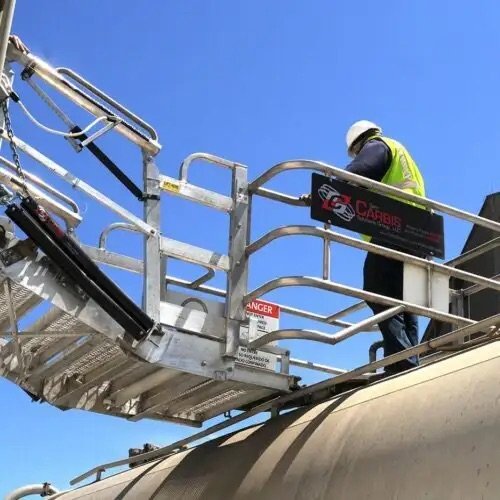
A worker on a gangway loading railcars

Moving from raw data to a working design plan usually follows a similar process, including:

  • Match Patterns to Access Points. Connect recurring near misses to the specific gangway, platform, or ladder where they occurred. This narrows your focus to the exact area that needs a design change.
  • Prioritize by Frequency and Severity. Address locations with the highest number of reports or the greatest potential severity first. This keeps limited resources focused on the biggest fall risk factors.
  • Bring in a Site Assessment Professional. A trained team can evaluate the flagged area and recommend platforms, cages, or enclosures suited to the task. This step turns raw data into a concrete engineering plan.
  • Match Equipment to the Task. Choose gangways, safety cages, or loading arms based on the specific hazard the data revealed, not a generic standard. Equipment that fits the actual task gets used properly by workers on every shift.

Each fix, once installed, works to reduce fall risk without waiting for another near miss to occur. Over time, this process turns a stack of individual reports into a system that keeps improving your site's access design. That ongoing loop, from data to design to review, is what keeps your operation ahead of emerging hazards.

Close Fall Risk Gaps with Carbis Solutions

Turning near-miss data into safer access design takes more than good intentions. It requires workers, safety teams, and design experts working from the same information. Every stage, from reporting to redesign, plays a part in reducing fall risk long term.

At Carbis Solutions, we partner with operations, safety, and engineering teams to close these gaps at every stage. We offer site assessments, hazard analysis, and custom-built gangways, platforms, and safety cages suited to your specific site. Reach out to our team to start turning your near-miss data into a safer access design.

Recent Posts

Better Access Starts with Engineering and Continues with Training

Ask an operator what makes a loading job difficult, and you probably won’t get an answer about the equipment’s finish. You’ll hear about the hatch that’s hard to reach, the truck that never seems to line up, or the awkward movement everybody’s learned to work around....

Let’s talk marine access

We use cookies to improve your experience. Please read our Privacy Policy or click Accept.
Cookies settings
Accept
Privacy & Cookie policy
Privacy & Cookies policy
Cookie name Active

Privacy Policy

What information do we collect?

We collect information from you when you register on our site or place an order. When ordering or registering on our site, as appropriate, you may be asked to enter your: name, e-mail address or mailing address.

What do we use your information for?

Any of the information we collect from you may be used in one of the following ways: To personalize your experience (your information helps us to better respond to your individual needs) To improve our website (we continually strive to improve our website offerings based on the information and feedback we receive from you) To improve customer service (your information helps us to more effectively respond to your customer service requests and support needs) To process transactions Your information, whether public or private, will not be sold, exchanged, transferred, or given to any other company for any reason whatsoever, without your consent, other than for the express purpose of delivering the purchased product or service requested. To administer a contest, promotion, survey or other site feature To send periodic emails The email address you provide for order processing, will only be used to send you information and updates pertaining to your order.

How do we protect your information?

We implement a variety of security measures to maintain the safety of your personal information when you place an order or enter, submit, or access your personal information. We offer the use of a secure server. All supplied sensitive/credit information is transmitted via Secure Socket Layer (SSL) technology and then encrypted into our Payment gateway providers database only to be accessible by those authorized with special access rights to such systems, and are required to?keep the information confidential. After a transaction, your private information (credit cards, social security numbers, financials, etc.) will not be kept on file for more than 60 days.

Do we use cookies?

Yes (Cookies are small files that a site or its service provider transfers to your computers hard drive through your Web browser (if you allow) that enables the sites or service providers systems to recognize your browser and capture and remember certain information We use cookies to help us remember and process the items in your shopping cart, understand and save your preferences for future visits, keep track of advertisements and compile aggregate data about site traffic and site interaction so that we can offer better site experiences and tools in the future. We may contract with third-party service providers to assist us in better understanding our site visitors. These service providers are not permitted to use the information collected on our behalf except to help us conduct and improve our business. If you prefer, you can choose to have your computer warn you each time a cookie is being sent, or you can choose to turn off all cookies via your browser settings. Like most websites, if you turn your cookies off, some of our services may not function properly. However, you can still place orders by contacting customer service. Google Analytics We use Google Analytics on our sites for anonymous reporting of site usage and for advertising on the site. If you would like to opt-out of Google Analytics monitoring your behaviour on our sites please use this link (https://tools.google.com/dlpage/gaoptout/)

Do we disclose any information to outside parties?

We do not sell, trade, or otherwise transfer to outside parties your personally identifiable information. This does not include trusted third parties who assist us in operating our website, conducting our business, or servicing you, so long as those parties agree to keep this information confidential. We may also release your information when we believe release is appropriate to comply with the law, enforce our site policies, or protect ours or others rights, property, or safety. However, non-personally identifiable visitor information may be provided to other parties for marketing, advertising, or other uses.

Registration

The minimum information we need to register you is your name, email address and a password. We will ask you more questions for different services, including sales promotions. Unless we say otherwise, you have to answer all the registration questions. We may also ask some other, voluntary questions during registration for certain services (for example, professional networks) so we can gain a clearer understanding of who you are. This also allows us to personalise services for you. To assist us in our marketing, in addition to the data that you provide to us if you register, we may also obtain data from trusted third parties to help us understand what you might be interested in. This ‘profiling’ information is produced from a variety of sources, including publicly available data (such as the electoral roll) or from sources such as surveys and polls where you have given your permission for your data to be shared. You can choose not to have such data shared with the Guardian from these sources by logging into your account and changing the settings in the privacy section. After you have registered, and with your permission, we may send you emails we think may interest you. Newsletters may be personalised based on what you have been reading on theguardian.com. At any time you can decide not to receive these emails and will be able to ‘unsubscribe’. Logging in using social networking credentials If you log-in to our sites using a Facebook log-in, you are granting permission to Facebook to share your user details with us. This will include your name, email address, date of birth and location which will then be used to form a Guardian identity. You can also use your picture from Facebook as part of your profile. This will also allow us and Facebook to share your, networks, user ID and any other information you choose to share according to your Facebook account settings. If you remove the Guardian app from your Facebook settings, we will no longer have access to this information. If you log-in to our sites using a Google log-in, you grant permission to Google to share your user details with us. This will include your name, email address, date of birth, sex and location which we will then use to form a Guardian identity. You may use your picture from Google as part of your profile. This also allows us to share your networks, user ID and any other information you choose to share according to your Google account settings. If you remove the Guardian from your Google settings, we will no longer have access to this information. If you log-in to our sites using a twitter log-in, we receive your avatar (the small picture that appears next to your tweets) and twitter username.

Children’s Online Privacy Protection Act Compliance

We are in compliance with the requirements of COPPA (Childrens Online Privacy Protection Act), we do not collect any information from anyone under 13 years of age. Our website, products and services are all directed to people who are at least 13 years old or older.

Updating your personal information

We offer a ‘My details’ page (also known as Dashboard), where you can update your personal information at any time, and change your marketing preferences. You can get to this page from most pages on the site – simply click on the ‘My details’ link at the top of the screen when you are signed in.

Online Privacy Policy Only

This online privacy policy applies only to information collected through our website and not to information collected offline.

Your Consent

By using our site, you consent to our privacy policy.

Changes to our Privacy Policy

If we decide to change our privacy policy, we will post those changes on this page.
Save settings
Cookies settings