Working at height brings real hazards, from slips and falls to unstable footing during loading. These risks become harder to manage when workers handle different vehicles on any given day. That is where adjustable work platforms come in.
Adjustable work platforms adapt to the vehicle in front of them instead of forcing workers to adapt. They change height, angle, and reach to match tank trucks, railcars, and containers. This article breaks down the specific ways that flexibility improves access and safety.
Adapting to Varying Vehicle Heights and Profiles
Tank trucks, railcars, and containers rarely match in height. A worker stepping onto a platform built for one vehicle often finds the deck too high, too low, or angled wrong for the next one. That mismatch forces awkward movements that raise the chance of a fall.
Adjustable work platforms help accommodate these differences in several key ways:
- Height adjustment. The platform raises or lowers to meet the vehicle at its actual deck height. This provides a more stable surface and reduces the need for workers to climb, reach, or stretch.
- Profile flexibility. The platform accommodates different vehicle shapes as well as varying heights. This matters for facilities that handle a mix of tank trucks, railcars, and containers on the same day.
- Consistent access procedure. Workers use the same basic steps to access every vehicle type. This lowers training time and reduces the chance of error from switching between setups.
Setting the platform to the correct height gives workers a stable starting point for every task. It removes the guesswork that leads to slips, missteps, and unstable footing. That stability is what makes adjustable platforms a safer choice for mixed vehicle fleets.
Closing the Gap Between the Platform and the Vehicle
Even a well-positioned platform can leave a gap between its edge and the vehicle. That gap creates a hazard every time a worker steps across it. Flatbed trailers are a common example, since their edges and deck heights vary between loads and often create access safety challenges unique to that vehicle type.
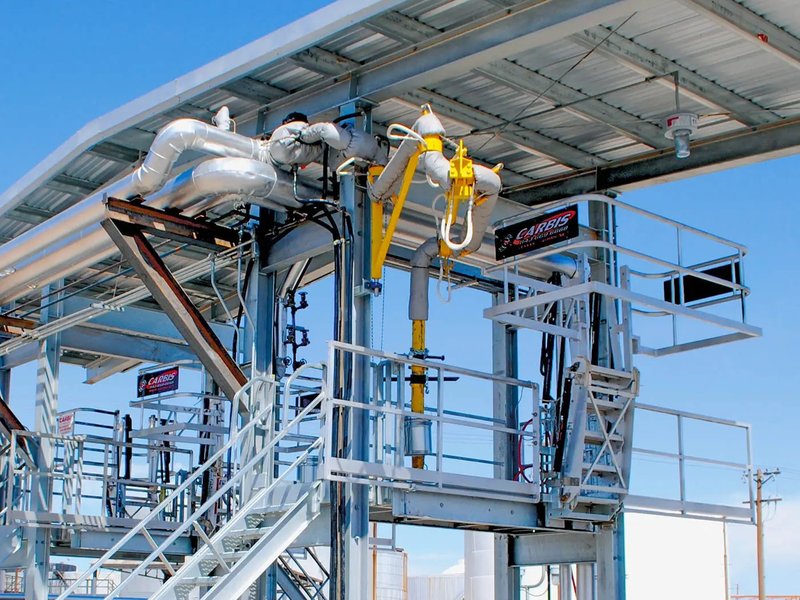
Adjustable work platforms address this gap in a few specific ways.
- Secure locking mechanism. These platforms can lock into place once positioned against the vehicle. This keeps the connection stable throughout loading or product transfer.
- Gangway extension. A gangway bridges the remaining distance between the platform and the vehicle. This gives workers solid footing instead of an open gap to cross.
- Edge protection. Handrails and edge barriers stay in place even as the platform adjusts. This keeps workers protected throughout the entire access process, not just at one fixed height.
Adjustable work platforms turn an unstable gap into a secure connection. In 2022, falls caused 423 of the 1,056 fatalities recorded in the construction industry, according to the Occupational Safety and Health Administration (OSHA). Closing that gap properly protects workers at the exact moment they are most at risk.
Reaching Multiple Access Points From a Single Structure
Some vehicles have more than one point workers need to reach. A tank truck may need a hatch on top and a valve on the side. Moving the entire platform for each point wastes time and adds unnecessary risk.
The right setup depends on matching access systems to workflows, since not every operation needs the same reach or configuration. Here is how adjustable work platforms reach different points without moving the whole structure:
- Track-mounted gangways. The gangway slides along a track to reach different points on the vehicle, allowing workers to adjust their position without repositioning the entire platform.
- Telescoping extensions. The platform extends outward to reach farther points without shifting position. This keeps footing stable even as the reach changes.
- Pivoting connections. The gangway rotates to align with access points at different angles. This gives workers a direct path instead of an awkward diagonal approach.
A single structure that reaches multiple access points reduces the need for workers to move around or reposition equipment. This reduces unnecessary movement while helping workers complete tasks safely and efficiently throughout every shift.
Cutting Down on Equipment Swaps and Layout Changes
Facilities that handle mixed vehicle types often end up with separate platforms for each one. That means more equipment to install, maintain, and store. It also means workers switch between different setups depending on the vehicle being handled.
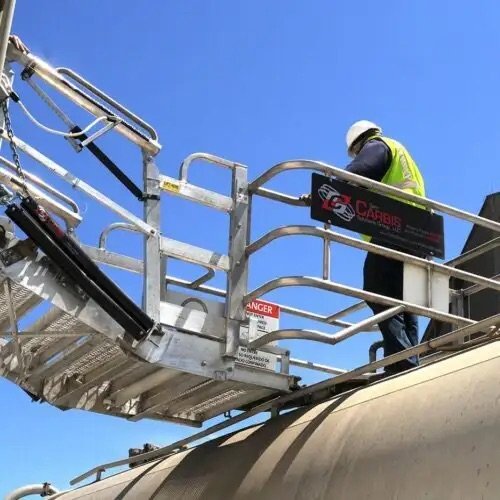
Adjustable work platforms remove that need entirely by providing the following benefits:
- Single system for multiple vehicles. One platform adjusts to fit tank trucks, railcars, and containers. This removes the need to install and maintain separate equipment for each vehicle type.
- Fits existing site layouts. The platform adapts to the space and infrastructure already in place. Facilities avoid costly layout changes or rebuilding around a fixed structure.
- Stays current as fleets evolve. The same platform continues to work even as vehicle types change over time. This protects the investment without requiring new equipment for every shift in fleet mix.
Fewer equipment changes can reduce opportunities for error. Workers can stay familiar with one system instead of adjusting to multiple setups. That consistency keeps access safe no matter what vehicle arrives next.
Partner with Us for Adjustable Work Platforms
Access should never depend on luck or improvisation. Workers need equipment that adjusts to the job, not the other way around. That principle is what makes adjustable work platforms a smarter long-term investment.
At Carbis Solutions, we design and build adjustable work platforms, gangways, and safe-access systems for facilities that handle mixed vehicle types. Our team works with you from site assessment through installation to make sure the system fits your operation. Reach out to our team to find the right access solution for your site.